What a limited company has to keep
GOV.UK lists what a company's accounting records must show: all money received and spent, assets, debts, stock and the goods bought and sold. Records must be kept for six years from the end of the financial year they relate to, and HMRC can fine a company £3,000 if they are not kept. Our guide to how long to keep business records works through the dates.
In practice that means one thing: every payment out of the company account should have a document behind it, and you should be able to find it years later.
Set up from Companies House
When you add your company, search for it at Companies House and Billfetch fills in the name. Linked companies get their next accounts and confirmation statement deadlines checked daily and shown in This month, with a warning when a date is close or overdue. These are reminders taken from Companies House, not advice; your accountant still does the filing.
Every invoice collected and matched
Suppliers can email invoices straight to the company's forwarding address. Receipts can be sent from your phone on Telegram or dropped in as files. Each document is read and checked: totals must add up, dates must make sense and duplicates are caught before approval.
Billfetch then pairs each payment with its invoice across Wise, Starling, Revolut Business, Stripe, PayPal and any bank you upload by CSV. A payment with no invoice goes on the missing list; an invoice with no payment shows up too.
Director's spending, kept visible
Two things blur a small company's books: company money spent on personal things, and personal money spent on company things. Billfetch handles both openly:
- A personal purchase on the company card is marked as personal. It is left out of the company's figures and counted, so your accountant can deal with it.
- A company invoice paid with your own card is marked as paid outside the company account. It is listed separately in the package so your accountant can treat it correctly, for example through the director's loan account.
- Bank fees and other payments that never come with an invoice can be recorded as expenses without an invoice, with the bank line as evidence.
VAT details your accountant can trust
Billfetch reads the VAT amount and rate from each invoice and records your VAT registration, scheme and accounting basis. Billfetch does not submit VAT returns or anything else to HMRC; it gives the person or software that does a clean, matched set of records and the documents behind them.
Spending in other currencies
Companies run from abroad, or buying from overseas suppliers, pay in dollars, euros or lira. Billfetch converts every amount to the company's base currency with HMRC's monthly exchange rates and keeps the original amount, currency and rate on each record. Card payments in another currency still match their invoices, allowing a small margin for the card's exchange rate.
Month end in one click
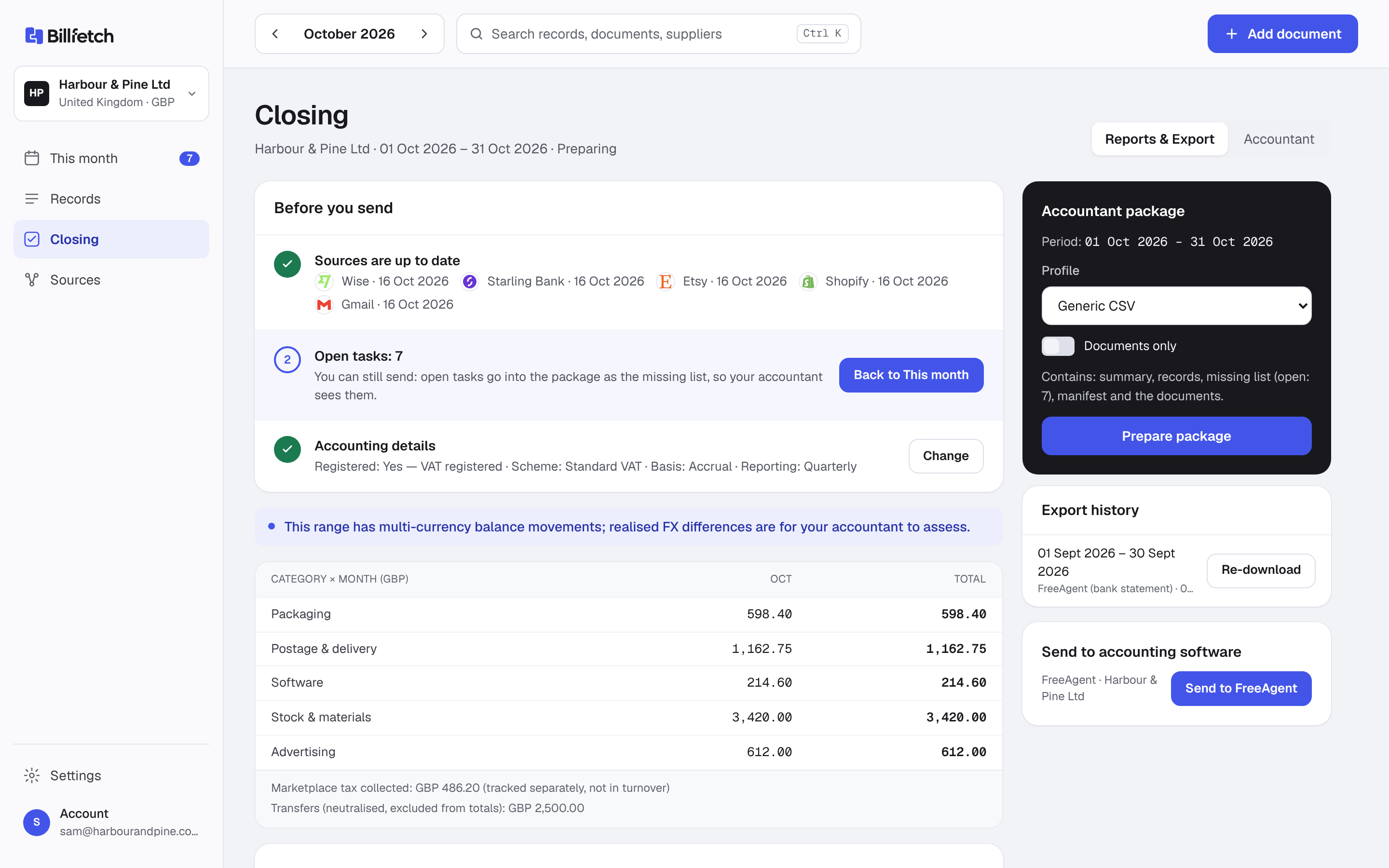
The Closing page checks that your sources are up to date and how many tasks are still open, then prepares the accountant package: a summary by category, every record with its exchange rate, the missing list, a manifest with a fingerprint for every document and the documents themselves. Choose a profile to add import files for Xero, QuickBooks Online or FreeAgent.
On the Business plan you can send expenses straight to FreeAgent or QuickBooks as bills with the invoice attached, and invite your accountant to read packages and ask questions on a record instead of emailing you. Our month-end checklist for a one-person company shows the routine step by step.
More than one company
Many directors run a trading company alongside a holding company, or a UK company next to one abroad. Each business keeps its own sources, base currency, rules and package, and one login covers them all. The Business plan includes up to three businesses; Group has no limit. See the pricing page.